https://youtu.be/ZqMLccin1JQ
Showing posts with label boulders. Show all posts
Showing posts with label boulders. Show all posts
Wednesday, April 25, 2018

Sunday, July 22, 2012
Landscaping in Santa Cruz: The Evolution Of A Mailbox

We installed this waterfall into his pool last year and he was very happy with our work.
In the design phase of his new front yard landscape, we noticed his mailbox could use an upgrade.

We decided to remove the hedge and build a new veneer stone mailbox pillar.
We also designed a front entryway staircase using dry laid natural stone.
The new design will open up the front of the house and make it feel more welcoming.


This picture also shows the new entryway steps. We used large Mossback slabs to create this custom and natural looking staircase. Some of the Mossback slabs weighed more than 800 pounds!
The footing for the pillar was 18 inches deep and two feet wide with a rebar every 8 inches. The footing for the pillar is very important. Make sure you do not cut corners on this part of the project, if you are building a pillar yourself. If you are in an area that freezes in the winter, you will need to put your footer below the frost line or the ground will heave and your pillar could fall over. Check with a local contractor in your area to get necessary depths for concrete footings.
 After the footing has set, we begin the block work.
The finished column will be 4 ft tall.
Block is mortared together with rebar laid on the top of each corse of block to create a grid of rebar throughout the column.


After the block is laid and filled, we install the stone veneer. We chose the El Dorado 'Durango Mountain Ledge' stone for this project.
We used a 'dry stack' walling style with this project.

Each stone is individually cut to create a custom fit and a very natural look.


Feel free to visit our website or Facebook page for more information and to see the different services we offer.
Living Waters Landscaping.com
Friday, February 18, 2011
Santa Cruz Landscaping: Boulder Placement
I have always enjoyed hiking and spending time in the woods. I love hiking in the Santa Cruz Mountains, especially on less traveled trails. I have also spent time in the Rocky Mountains of Colorado, and the deserts of New Mexico. I purposely seek out high rock outcroppings and large boulders when I am hiking. I love sitting next to a boulder or on top of a grouping of rocks. I am humbled by their timeless strength and peaceful presence.
 In my landscape designs, I always try to incorporate artistic boulder placement in the project. Whether its a grouping of boulders in a garden, a large boulder placed in a water feature, or a stand alone boulder feature.
I take my time in choosing each rock that I will place in the garden. I look at the features and characteristics of the boulder, and I imagine it in the garden with plant life around it.
This is a feature we did on the West side of Santa Cruz. It was an existing cactus garden that we installed a small pathway through.

 At one point in the path, we placed a large flat stone, and carried the pathway around it. The garden itself housed many 50-100 year old cactus and Agave plants. So we chose this stone to look as if it was a huge buried boulder that had been unearthed by the weather over hundreds of years. This took an eye for choosing the right rock, as well as for placing it. For the pathway, we chose a stone that is native to the Arizona dessert. It is a path stone or flagstone that is harvested from the surface. Most flagstone is harvested in sheets that are excavated from under the ground. This stone has been weathered over time and even has lichen and moss growing on it. It went well with the ancient look we were shooting for.
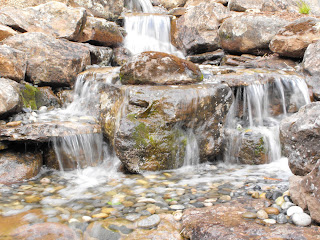 I also enjoy placing large boulders in a water feature. It gives the feature a more balanced and aged look.
Having a variety of sizes of stone in a waterfall helps it to blend in and look natural.
I still have a lot to learn about setting boulders in a landscape, I enjoy it a lot and I will keep studying and learning as I go.
www.livingwaterslandscaping.com

I take my time in choosing each rock that I will place in the garden. I look at the features and characteristics of the boulder, and I imagine it in the garden with plant life around it.
 |
| Cactus Garden Pathway |

 At one point in the path, we placed a large flat stone, and carried the pathway around it. The garden itself housed many 50-100 year old cactus and Agave plants. So we chose this stone to look as if it was a huge buried boulder that had been unearthed by the weather over hundreds of years. This took an eye for choosing the right rock, as well as for placing it. For the pathway, we chose a stone that is native to the Arizona dessert. It is a path stone or flagstone that is harvested from the surface. Most flagstone is harvested in sheets that are excavated from under the ground. This stone has been weathered over time and even has lichen and moss growing on it. It went well with the ancient look we were shooting for.
 I also enjoy placing large boulders in a water feature. It gives the feature a more balanced and aged look.
 Having a variety of sizes of stone in a waterfall helps it to blend in and look natural.
I still have a lot to learn about setting boulders in a landscape, I enjoy it a lot and I will keep studying and learning as I go.
www.livingwaterslandscaping.com
Subscribe to:
Posts (Atom)